

New discoveries about Luocheng Site
2024-06-28
Luocheng Site, located on the west bank of Miluo River in Luocheng Ancient Village, Heshi Town, Yueyang City, is known as an important southern town of the Chu State during the Warring States period. It’s also one of the earliest locations in Hunan Province where the typical Chu culture was found.
Luocheng was built in the middle and late Warring States period. In 2023, the archaeological excavation results of the eastern section of the north wall of the city site by the Hunan Provincial Institute of Cultural Relics and Archaeology once again confirmed this.
The Gaoquanshan Tombs are located in the southeast of the Luocheng Site, only 4 kilometers apart. In 1993, a high-grade tomb was excavated here, and the bronze plate unearthed had the inscription “Luozi”, which is consistent with the record in the literature. So the Luocheng Site is likely the place where Chu resettled the descendants of Luozi State.
In 2023, archaeological excavations were conducted on the Gaoquanshan Tombs. A total of 64 tombs from the Eastern Zhou Dynasty and 6 tombs from the Qing Dynasty were excavated.
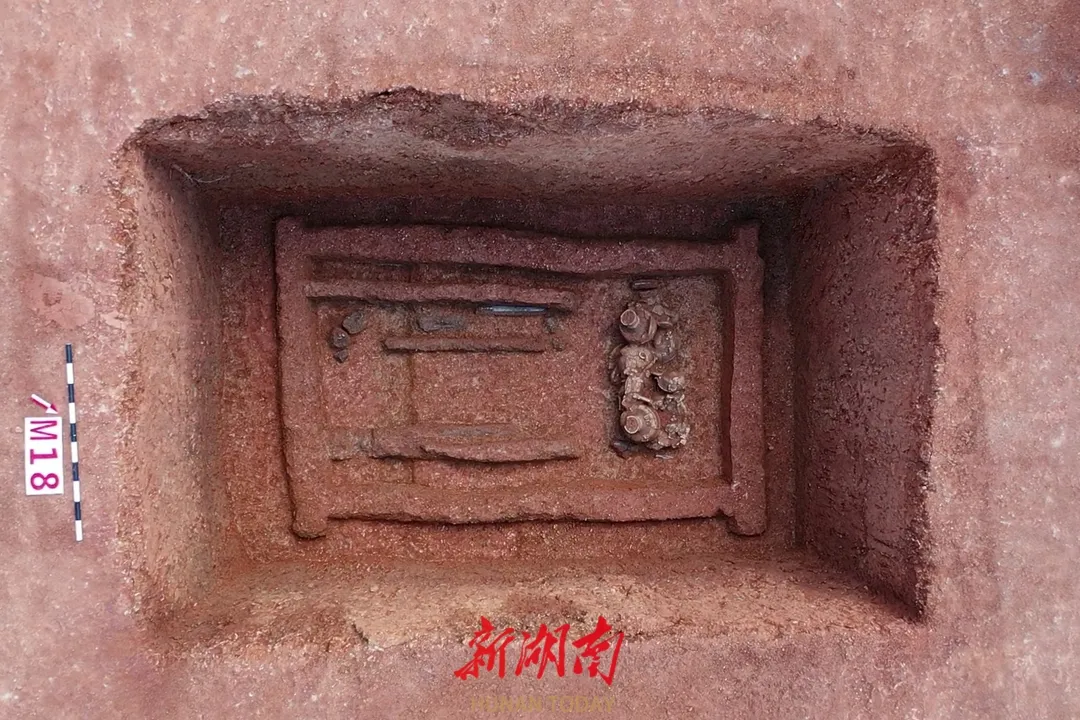
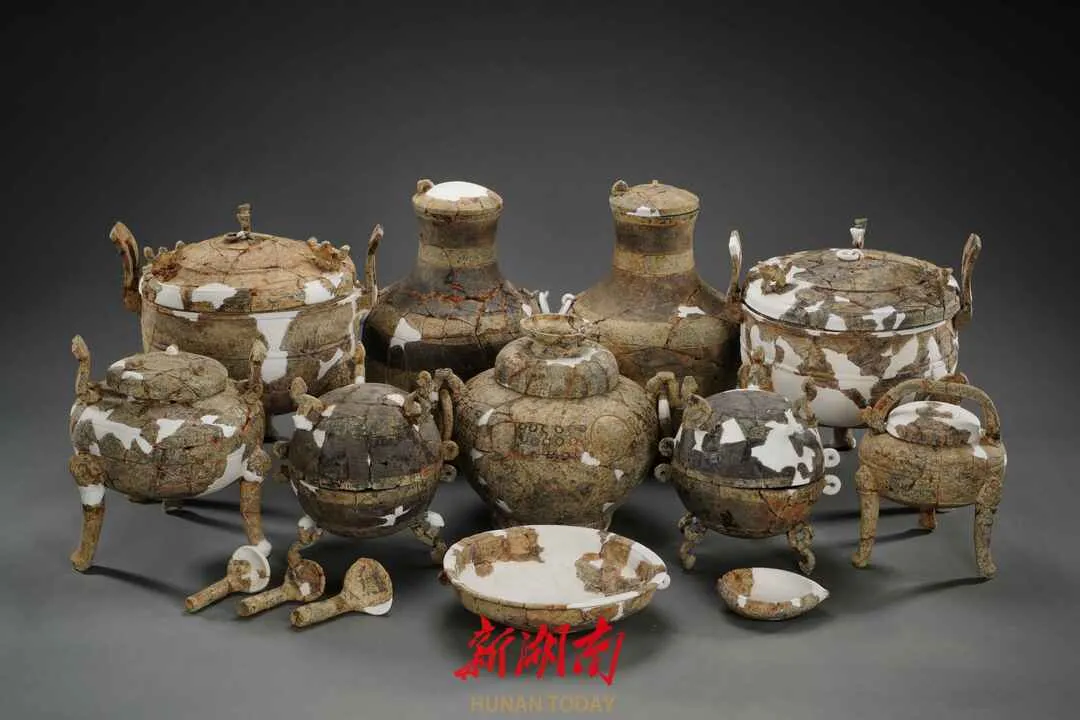
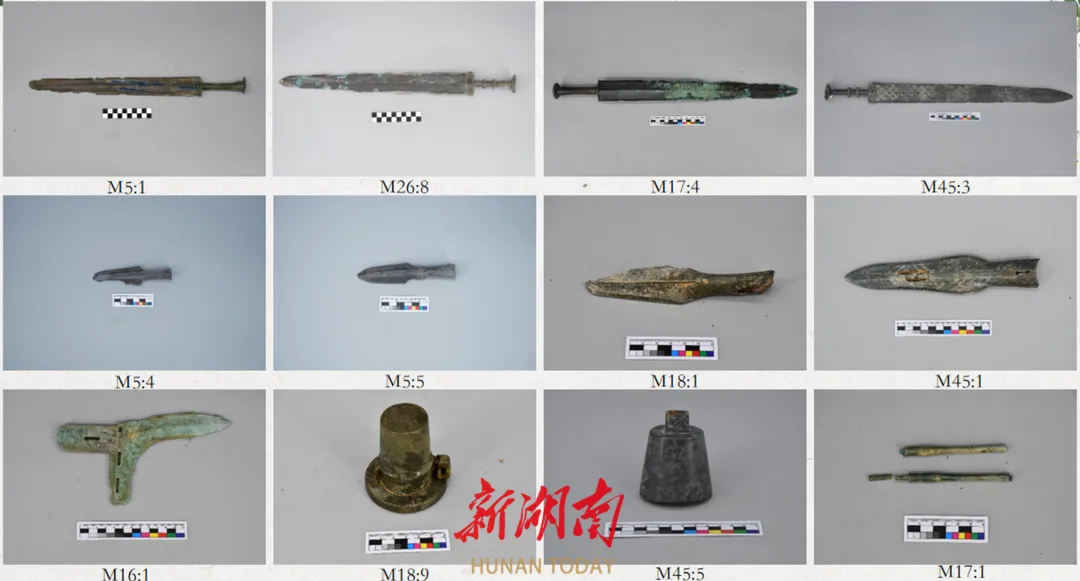
It’s worth mentioning that 64 tombs from the Eastern Zhou period are rectangular vertical pit tombs, and 32 tombs have burial objects. Except for copper ritual vessels unearthed from one tomb, all other burial objects unearthed from the tombs were imitation copper and pottery ritual vessels, domestic pottery ware, and copper weapons.
From the tomb shape, combination of artifacts, and characteristics of artifacts, the Gaoquanshan Tombs are typical Chu tombs.
“Judging from the unearthed artifacts, we know that most of the tombs are not of high grade. The shapes and patterns of the unearthed pottery ware are almost the same as those in Jiangling, Hubei Province. These tombs are mainly from the early and middle Warring States Period, and some tombs are from the late Spring and Autumn Period. In terms of age, they can basically be connected with the two high-grade tombs with burial bronze ware excavated before, and the owners of the tombs are perhaps the survivors of the Luozi State.”
Wei Xingxing said that the unearthed pottery ware mainly consists of imitation copper and pottery ritual vessels like tripod, Gui (a round-mouthed food vessel with two or four loop handles) and Yi (an ancient utensil shaped like a ladle used to hold water and wine), while there are few domestic pottery ware objects.
The unearthed copper weapons mainly include swords, spears, and arrowheads.
Among the 32 tombs with burial objects, 8 tombs only have copper weapons. Further research is needed to be done by archaeologists on the unearthed artifacts to explore the underlying reasons.
“The Chu people failed to move northward and shifted their focus to the south. During the construction of the city walls at the Luocheng Site, the main tomb area shifted from Gaoquan Mountain to the Miluo Mountains on the east bank of the Miluo River. The number of tombs increased sharply compared to before, possibly due to the establishment of Luoxian County by the Chu State and the shift of its focus to the south.”
Wei Xingxing said that the archaeological excavation results of the Gaoquanshan tombs in 2023 provided important archaeological data for studying the historical, cultural, and social development status of ancient residents in this area, as well as Chu’s management of the lower reaches of the Xiangjiang River.
